

Delamination in multi-layer fabric laminating is a mechanical bond failure where constituent textile layers separate due to inadequate cohesive strength or incomplete polymer wet-out at the interface. This manufacturing defect occurs when the adhesive matrix-typically a thermoplastic Polyamide (PA), Polyester (PES), or TPU Web-fails to establish a continuous cross-linking or mechanical lock with the substrate fibers. To systematically eliminate these bonding issues, material engineers must optimize the balance between thermal energy transfer, nip roll pressure, and adhesive weight (gsm), ensuring that the boundary peel strength consistently meets or exceeds the industrial baseline of 45 N/cm.
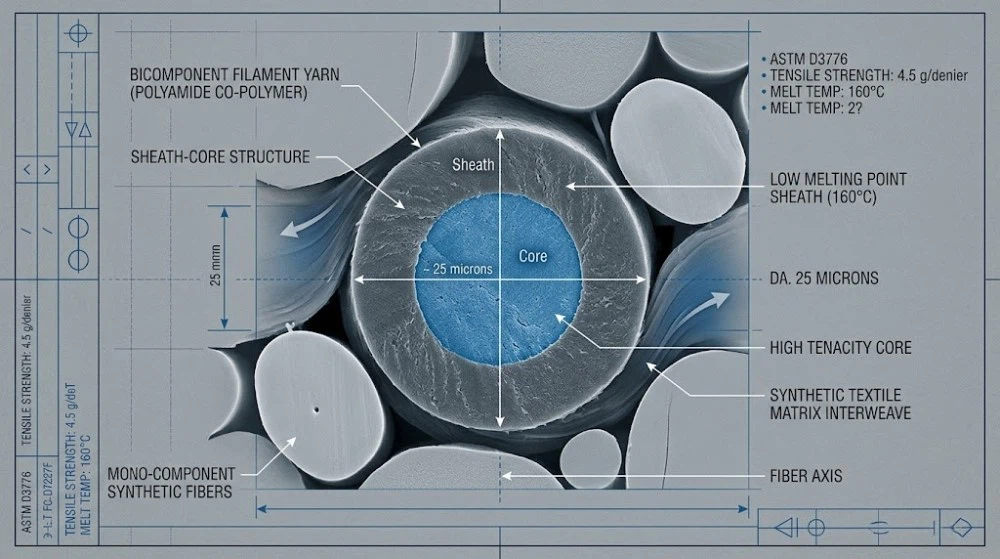
Root Cause Analysis of Interface Adhesion Failure
Delamination typically originates from three distinct thermodynamic and mechanical variances during the lamination cycle:
Thermal Inversion (Under-activation): The core interface fails to reach the polymer's precise melting point window (e.g., 110°C to 120°C for PES), preventing molecular diffusion across the boundary layer.
Viscosity Collapsing (Over-activation): Excessive temperature reduces the adhesive viscosity below critical thresholds, causing the polymer to sink too deeply into the porous carrier fabric, leaving an empty interface.
Pressure Atrophy: Insufficient structural pressure prevents the molten polymer from wetting out irregular woven or non-woven surfaces, generating micro-voids that propagate macro-tears under cyclic stress.
Submit your failure analysis reports to our laboratory for a technical bonding diagnostic and complimentary material matching.
Technical Calibration: Temperature, Pressure, and Dwell Compensation
To secure a stable lamination boundary, processing parameters must be strictly calibrated based on the specific thermal conductivity and thickness of the face and lining fabrics.
Data Table: Optimization Parameters for Multi-Layer Composites
The following table serves as a technical white paper guide to resolve delamination issues across common synthetic textile combinations:
| Laminate Profile | Recommended Adhesive Medium | Interface Activation Temp | Applied Cylinder Pressure | Dwell Time | Baseline Peel Strength |
| 3-Layer Nylon Ripstop | 20 gsm Co-PA Web | 115°C – 125°C | 3.0 – 4.0 bar | 12 – 15 sec | ≥ 48 N/cm |
| Polyester Spacer Mesh | 35 gsm Co-PES Web | 135°C – 145°C | 4.5 – 5.5 bar | 20 – 25 sec | ≥ 55 N/cm |
| Lycra to Elastic Knit | 25 gsm High-Flex TPU Web | 120°C – 130°C | 2.5 – 3.5 bar | 15 – 18 sec | ≥ 50 N/cm |
| Synthetic Leather Composite | 50 gsm Co-PA Film | 110°C – 120°C | 4.0 – 5.0 bar | 22 – 30 sec | ≥ 45 N/cm |
Selecting the Correct Web Weight (gsm) for Structural Integrity
A common miscalculation in fabric laminating line architecture is matching low-weight adhesive webs with high-density, highly porous open-end yarns.
8g to 15g/㎡ Webs: Reserved strictly for lightweight, close-weave apparel fabrics under 100 gsm. Utilizing ultra-light webs on thick meshes creates immediate starvation-driven delamination.
20g to 45g/㎡ Webs: The industrial standard for performance footwear and automotive interior components. This range provides sufficient polymer volume to fill the fiber interstices while retaining necessary flex-fatigue life and breathability.
50g to 80g/㎡ Webs: Deployed in heavy industrial composites and luggage lining matrices requiring maximum tensile strength and high puncture resistance.
Production Auditing via Technical Diagnostics
To achieve a zero-defect line, quality control protocols must integrate continuous cross-sectional testing. Material engineers can reference our updated Knowledge database for standardized ASTM D1876 T-peel test procedures to catch micro-voiding prior to large-scale roll winding. Furthermore, ensuring that the moisture vapor transmission rate (MVTR) and air permeability align with target metrics prevents internal condensation buildup, which is a leading secondary cause of environmental hydrolysis delamination over extended storage cycles.
FAQ
Q1: What is the minimum order quantity (MOQ) for custom-weight PA or PES adhesive webs?
Our factory standard MOQ for stock configurations (15g to 30g) is 1,000 meters per roll. For custom-engineered gsm specs or specific widths ranging from 10mm to 3200mm to limit processing scrap, the processing line MOQ is 5,000 square meters.
Q2: How do your adhesive webs perform under GRS and Oeko-Tex certification audits?
All WithTech thermoplastic webs carry Oeko-Tex Standard 100 Class I certification, validating zero hazardous gas release during high-temperature hot-press bonding. We also furnish GRS certified recycled options with fully auditable Transaction Certificates (TC) for every batch.
Q3: Can your adhesive webs resolve delamination in water-repellent (DWR) treated textiles?
Yes. For textiles coated with fluorocarbon or C6 DWR finishes, standard glues fail due to low surface energy. We have developed modified co-polyamide webs with adjusted melt flow indexes that successfully penetrate DWR boundaries to establish a permanent mechanical lock.


