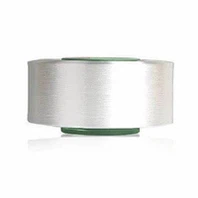
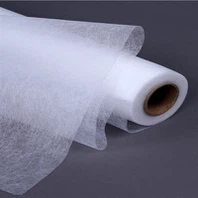
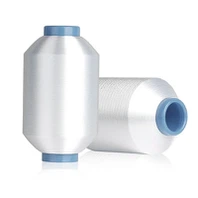
At room temperature, the hot fuse and other fibers are woven into a fabric, and then under dry heat or moist heat, pressure is applied to the fabric. When the temperature is higher than the melting point of the hot fuse, the hot fuse gradually melts. At this temperature, the conventional other fibers remain unchanged and are thus bonded together by the thermal fuse. Therefore, the hot fuse can replace chemical adhesives such as glue, avoid the pollution of volatiles and powder layers, and be environmentally friendly and non-toxic; at the same time, it saves the process flow and reduces the downstream production cost.
1. high strength. The short fiber strength is 2.6 to 5.7 cn/dtex, and the high tenacity fiber is 5.6 to 8.0 cN/dtex. Due to its low hygroscopicity, its wet strength is basically the same as its dry strength. The impact strength is 4 times higher than that of nylon and 20 times higher than that of viscose fiber.
2. Good elasticity. The elasticity is close to that of wool, and it can almost fully recover when the elongation is 5% to 6%. The wrinkle resistance exceeds other fibers, that is, the fabric does not wrinkle and has good dimensional stability. The elastic modulus is 22~141cN/dtex, which is 2~3 times higher than that of nylon. Polyester fabric has high strength and elastic recovery, so it is durable, wrinkle-resistant and easy-to-press.

3. Heat-resistant polyester is made by melt spinning, and the formed fibers can be heated and melted again, and belong to thermoplastic fibers. The melting point of polyester is relatively high, and the specific heat capacity and thermal conductivity are relatively small, so the heat resistance and thermal insulation of polyester fibers are higher. Is the best of synthetic fibers.
4. Good thermoplasticity and poor melting resistance. Due to the smooth surface of polyester and the close arrangement of internal molecules, polyester is the most heat-resistant fabric in synthetic fabrics. It has thermoplastic properties and can be made into pleated skirts with long-lasting pleats. At the same time, polyester fabric has poor melting resistance, and it is easy to form holes when encountering soot, sparks, etc. Therefore, try to avoid contact with cigarette butts, sparks, etc. when wearing.
5. Good abrasion resistance. The abrasion resistance is second only to the nylon with the best abrasion resistance, and it is better than other natural fibers and synthetic fibers.
At present, hot fuse is widely used in outdoor sports shoe uppers, casual shoe uppers, sofa fabrics, curtain screens, carbon fiber fabrics, chenille yarns, Bondi threads, high-end suit linings, lace and glove overlock yarns, etc. It is a high-tech product with huge market prospects.