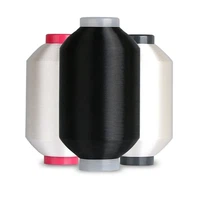
Fiber bonding (or fiber stickiness) during hot melt yarn production is a critical challenge that impacts product quality, particularly during high-temperature melting and fiber stretching. Below is a systematic solution covering material selection, process optimization, and equipment improvements:
1. Root Causes of Fiber Bonding
| Production Stage | Causes | Impacts |
|---|---|---|
| Melting Stage | Over-melting or uneven temperature distribution increases fiber surface viscosity. | Fiber clumping, uneven yarn diameter. |
| Stretching Stage | Improper tension control causes unmelted polymer particles to accumulate. | Higher yarn breakage, increased fuzz. |
| Cooling Stage | Insufficient cooling rate leaves residual stickiness between fibers. | Yarn layers adhere, making unwinding difficult. |
2. Key Strategies and Technical Solutions
2.1 Material Selection and Modification
Reduce Melt Fluidity:
Use broad molecular weight distribution polymers (e.g., PA6/PA66 blends) to lower melt flow index (MFI).
Add inorganic fillers (e.g., nano-silica, talc) to increase melt viscosity (+20–30%).
Anti-Bonding Modifications:
Apply release agents (e.g., silicone oil emulsion, 0.5–1.0 wt%) to reduce surface energy (contact angle >100°).
Blend anti-blocking masterbatches (e.g., EBS ethylene bis-stearamide, 0.3–0.8 wt%).
2.2 Process Parameter Optimization
Zoned Temperature Control:
Melting Zone: Gradual heating (e.g., PA6: 220°C→240°C→260°C) to avoid localized overheating.
Stretching Zone: Temperature set 10–20°C above polymer Tg (e.g., PET: 80–90°C) to prevent bonding.
Tension and Speed Matching:
Maintain a draw ratio (DR) of 3–5x and guide roller speed deviation <±2%.
Use dynamic tension sensors (e.g., Siemens Simatic RTU) for real-time adjustments.
Rapid Cooling Techniques:
Air Quenching: High-pressure cool air (15–20 m/s) solidifies melt in 0.1–0.5 seconds.
Water-Cooled Rolls: Surface temperature <25°C, contact time >2 seconds (for high-melting fibers like PEEK).

2.3 Equipment Upgrades
Yarn Guide System Design:
Use ceramic-coated guides (friction coefficient <0.1) to reduce polymer buildup.
Optimize guide roller spacing (gap = fiber diameter × 50) to prevent cross-contact.
Melt Homogenization:
Install static mixers (e.g., Sulzer SMX) to ensure uniform melt (temperature fluctuation <±1°C).
Replace round dies with slot dies to shorten melt flow paths by 30%.
Real-Time Monitoring:
Infrared thermography (FLIR A700) tracks melt temperature distribution for auto-adjustments.
Laser diameter sensors (Keyence LS-9000) ensure fiber diameter tolerance of ±0.01 mm.