

Hot melt yarn can be categorized by material, structure, and function. Each type has distinct features and is suitable for different applications:
By Material
Polyester (PET) Hot Melt Yarn
Characteristics: High strength, abrasion resistance, good chemical stability. Common melting points are 110°C or 180°C. Offers stable physical and chemical properties and strong bonding performance, making it suitable for a wide range of textile processes.
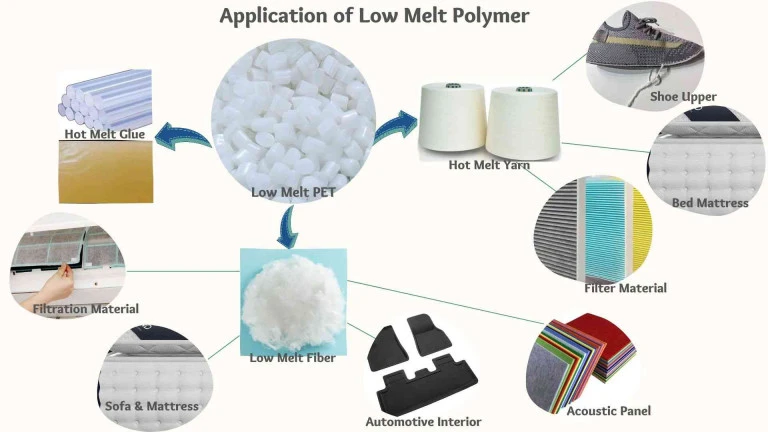
Applications: Shoe uppers, home textiles, automotive interiors, filtration materials, carpets, etc.
Nylon (Polyamide) Hot Melt Yarn
Characteristics: Mainly fully-melting type, with a lower melting point (around 90°C). Excellent softness and bonding properties, ideal for fabrics requiring a soft hand feel.
Applications: Garment interlinings, footwear materials, home textiles, bonding threads, etc.
By Structure
Fully-Melting Hot Melt Yarn
Characteristics: The entire fiber melts when heated, providing thorough bonding. Suitable for applications requiring complete thermal adhesion.
Semi-Melting (Sheath-Core Composite) Hot Melt Yarn
Characteristics: The outer layer is made of low-melting-point material, while the core is a regular fiber (such as standard polyester). Upon heating, only the sheath melts, ensuring good bonding while retaining strength and elasticity.
By Melting Point
| Type | Melting Point Range | Features & Suitable Applications |
|---|---|---|
| Low-Temperature Type | 85–130°C | Suitable for heat-sensitive materials, soft hand feel, used in garments, home textiles, bedding, etc. |
| Medium-Temperature Type | 130–160°C | Moderate bonding strength, good heat resistance, ideal for general industry and automotive interiors |
| High-Temperature Type | 160°C and above | High bonding strength, excellent heat resistance, used in heavy industry and high-temperature environments |
By Function
Elastic Hot Melt Yarn: Combines elasticity and thermal bonding, suitable for sportswear and stretch fabrics.
Flame-Retardant Hot Melt Yarn: Treated for flame resistance, suitable for children's clothing, bedding, and other safety-critical fields.
Antibacterial Hot Melt Yarn: Contains antibacterial agents, suitable for medical and hygiene products.
Conductive Hot Melt Yarn: Contains conductive materials, suitable for smart textiles and wearable electronics.
Summary
Different types of hot melt yarn offer various advantages in terms of melting point, strength, softness, and functionality. Selection should be based on specific application requirements-such as desired bonding strength, heat resistance, softness, or special functions-to achieve optimal product performance.


